
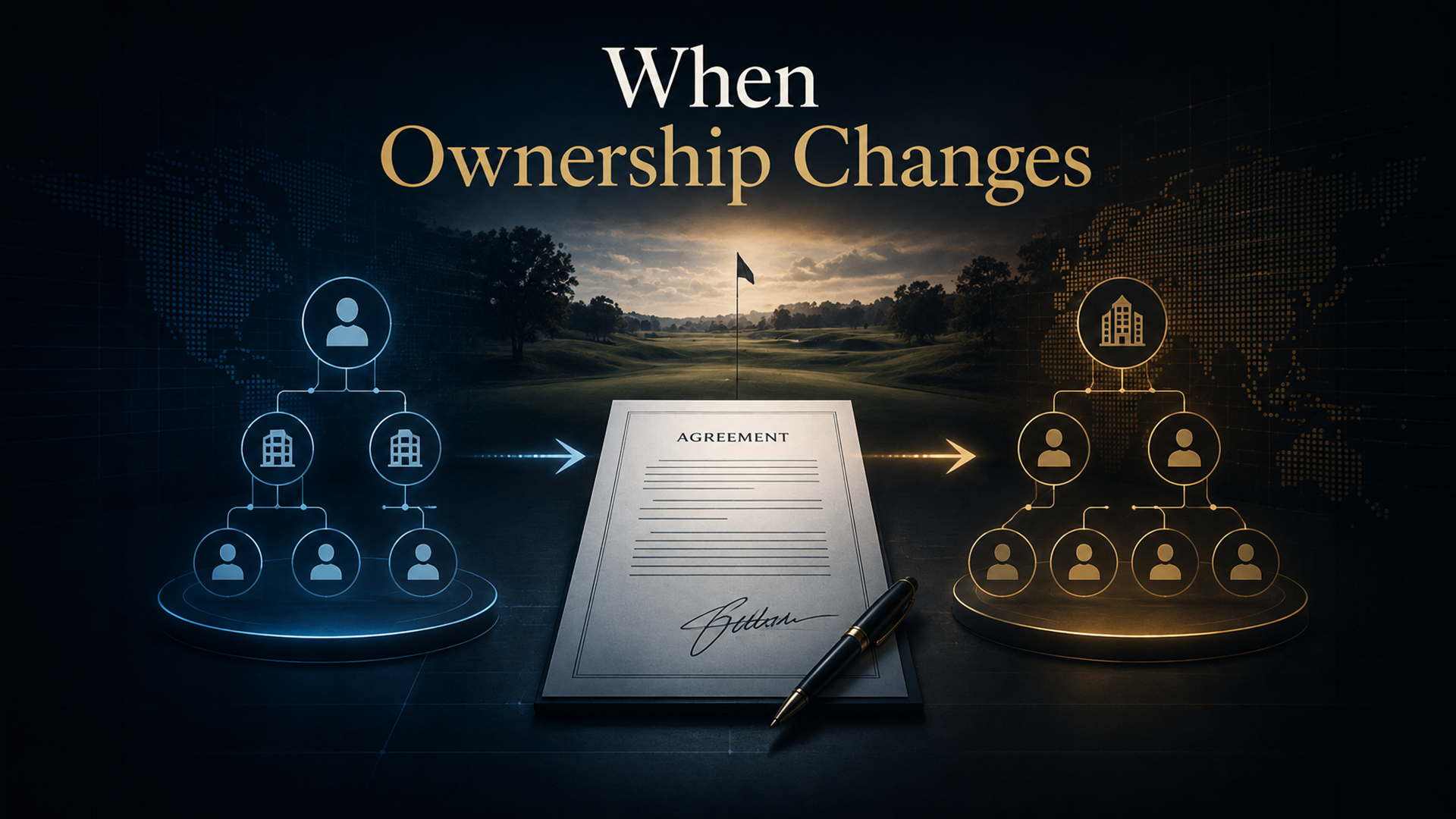
What Happens to a Contract When the League Behind It Changes Hands?
By Jay Kotzker
Lessons in change-of-control risk from LIV Golf’s uncertain future
For four seasons, LIV Golf’s story has been one of guaranteed money: nine-figure contracts, Saudi-backed stability, and a promise that players’ financial futures were locked in regardless of how the golf itself played out.
That promise is now being tested. Earlier this year, the Public Investment Fund, LIV’s sole financial backer since its 2021 founding, announced it would pull its funding at the end of the 2026 season. In the months since, the league has scrambled to find a replacement, floated a plan to convert players into equity holders instead of salaried talent, and continued operating under a cloud of unpaid-invoice lawsuits and a canceled season-ending event.
Whatever happens to LIV Golf specifically, the underlying legal question is universal: what happens to your contract when the entity on the other side of it changes — through new ownership, a merger, a restructuring, or a total collapse?
The Clause That Matters Most: Assignment and Change of Control
Most people focus on the headline terms of a contract: compensation, term, exclusivity. But when an organization’s ownership shifts, the provisions that actually determine your fate are often buried further down: assignment clauses and change-of-control provisions.
An assignment clause governs whether either party can transfer its rights and obligations under the contract to a new entity without the other side’s consent. If a league, team, or company is sold and the contract is silent or, worse, freely assignable, the counterparty may find itself bound to an entirely different organization, with different priorities, financial backing, and appetite for honoring prior commitments.
A change-of-control provision goes a step further. It can trigger specific consequences — renegotiation rights, termination options, acceleration of payment, or approval requirements — the moment ownership shifts beyond a defined threshold. For athletes, executives, licensors, and vendors alike, this is the clause that determines whether a change in ownership is a non-event or an opportunity to walk away (or demand better terms).
What “Successor-in-Interest” Really Means
When a new owner or investor steps in, they don’t automatically inherit every obligation of the old entity, it depends on how the deal is structured. An asset purchase, a stock purchase, and a bankruptcy reorganization each carry very different consequences for existing contracts:
- Stock or equity acquisitions generally leave existing contracts intact, since the legal entity itself hasn’t changed — only who owns it.
- Asset purchases can allow a buyer to selectively assume only the contracts it wants, potentially leaving others behind entirely.
- Insolvency or restructuring scenarios may allow contracts to be rejected altogether, leaving the counterparty as an unsecured creditor rather than a party with an enforceable agreement.
This is precisely the terrain LIV’s situation raises: if a new lead investor takes over funding and structure, whether existing player contracts survive intact — or get renegotiated as part of the transition — depends heavily on how that deal is papered, not just on public statements of intent.
“Guaranteed” Isn’t Always Guaranteed
LIV’s contracts were widely reported as fully guaranteed. But a guarantee is only as strong as the entity backing it — and its enforceability during a funding transition depends on the underlying protections in place: indemnification language, escrow or reserve requirements, parent-company guarantees, and remedies for late or missed payments. Without these, a “guaranteed” contract can become, practically speaking, a claim in line behind other creditors.
What This Means Beyond Golf
This isn’t just a sports story. The same issues arise any time a business is on the receiving end of a contract with an organization that could be acquired, restructured, or lose its funding; talent agreements, licensing deals, vendor contracts, franchise agreements, and commercial leases all carry the same exposure. The practical takeaway for any party negotiating a long-term agreement:
- Don’t leave assignment silent. Require consent before your contract can be handed off to a new owner.
- Negotiate change-of-control triggers. Build in rights to renegotiate, accelerate payment, or exit if control changes hands.
- Understand what “guaranteed” actually rests on. Ask what security, escrow, or parent guarantees stand behind that promise.
- Watch deal structure, not just headlines. How a transaction is structured — asset sale, equity sale, restructuring — determines whether your contract survives at all.
Whether LIV Golf’s next chapter brings stability or further upheaval, the situation is a useful reminder that the strength of any contract is only as good as the protections built into it before the other side changes.
This post is intended for general informational purposes and does not constitute legal advice. Contract structuring, change-of-control provisions, and successor liability are highly fact-specific and vary by jurisdiction and transaction type. For guidance on a specific agreement or transaction, please contact Holon Law Partners, LLP.