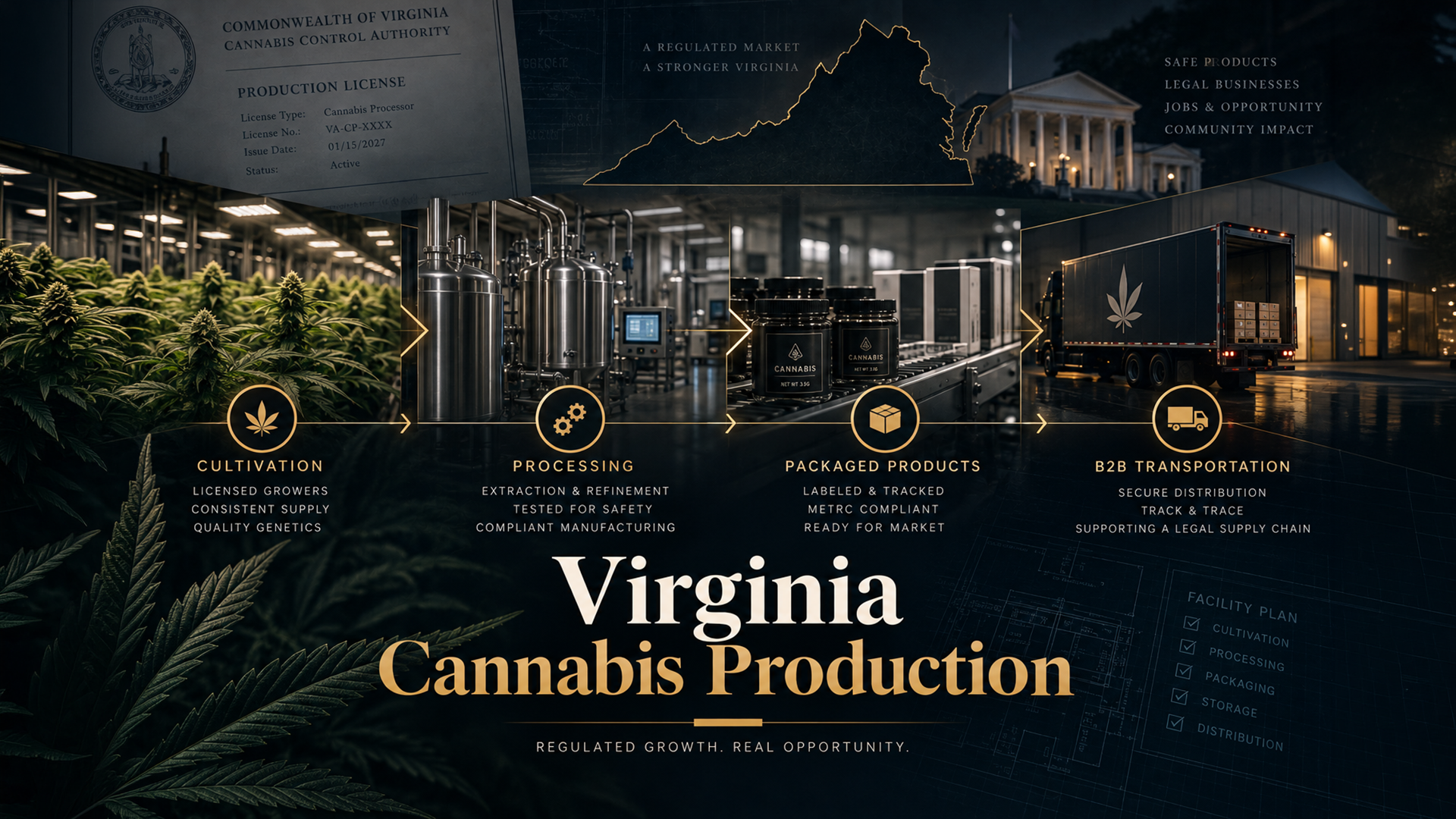

Virginia Adult-Use Marijuana Market Overview
By Aaron Tucker
After passing cannabis reform this summer through a unique budgetary process, Virginia is set to begin issuing adult-use licenses next year, and it is shaping up to be one a significant opportunity.
Recent data from the National Survey on Drug Use and Health suggests that more than 21% of adults in the commonwealth, or roughly 1.65 million individuals, consume cannabis at least occasionally. By contrast, the Virginia Cannabis Control Authority (CCA) reports that the current medical cannabis program served just under 115,000 unique patients in 2025.
At the same time, numerous legislative changes, including a lapse of provisions that allowed so-called ratio hemp products are set to upend the state’s hemp market, which previously provided limited retail access to THC products. These forces are likely to drive significant demand towards newly licensed adult-use operators, and, correspondingly, are already driving tremendous interest in the Virginia market.
Holon Law has received many inquiries from businesses interested in breaking into the Virginia adult-use cannabis market. This first article in our series on the Virginia market provides a basic overview of the anticipated licensing framework and process. In the coming weeks we will be taking deeper dives into each license type and other key features of this emerging market.
License Types
Virginia will offer 7 unique adult-use license types, which are largely similar to those we have seen in other state cannabis programs.
- Cultivation Facility: Cultivation facilities are authorized to cultivate, label, and package marijuana, and to both sell and transport it to other licensed establishments. Virginia is set to offer 5 tiers of cultivation facility license; with the smallest tier authorizing up to 5,000 square feet of flowering canopy, and the largest authorizing up to 35,000 square feet. Initially, by law, Virginia will only approve up to 5 of the largest tier facilities. Additional limits will be subject to the discretion of the CCA.
- Processing Facility: For now, Virginia law is fairly hands-off compared to other state cannabis programs when it comes to processors, though additional restrictions and guidance are expected via regulation. Edibles and similar products are limited to 10mgs of THC per serving, and up to 100mgs per package. Unsurprisingly, processers producing edibles will be subject to additional inspection and regulation by VDACS as a food manufacturer.
- Testing Facility: Virginia requires that licensees contract with an independent testing facility licensee to test all adult use marijuana products for residual solvents, heavy metals, microbiologicals, mycotoxins, pesticides and chemicals, and “active ingredients” (i.e., potency). A testing facility must have ISO/IEC 17025 accreditation and owners of testing facility licenses cannot have any interest in almost any other part of the supply chain.
- Retail Marijuana Store Retail marijuana stores are authorized to sell and, importantly, deliver up to two ounces of marijuana or an equivalent amount of marijuana products, as well as clones and seeds, to individuals 21 and up subject to numerous restrictions. By law, the Cannabis Control Authority is not authorized to issue more than 350 retail licenses; so, competition for these limited licenses is expected to be fierce.
- Delivery Operator: Delivery operators, like retail marijuana stores, are authorized to deliver marijuana and marijuana products from a retail store to a residence.
- Transporter licensee Transporter licensees are authorized to transport marijuana and marijuana products between licensed businesses. Notably however, each licensee within the supply chain apparently already has all transportation authorizations that are, as a practical matter, necessary to carry out their business without resorting to an independent transporter. It remains to be seen what role transport licenses ultimately have in the supply chain.
- Microbusiness: Virginia’s take on the microbusiness license offers operators an opportunity to create a small-scale vertical model. The microbusiness is authorized to cultivate, process, and sell cannabis products to consumers. While other license types are limited to a single location per license, a microbusiness can operate two; a production location and a retail location, which must be within 20 miles of the production site.
Licensing Process
As discussed above, the CCA is not authorized to issue more than 5 Tier V Cultivation licenses, or more than 350 retail licenses. The CCA is also empowered to establish additional license limits for other types of licenses based on a variety of factors.
In the event that there are more applications passing preliminary review than there are available licenses of that type, the CCA is required to conduct a split lottery; allocating at least half of the available licenses to impact applicants in a separate draw, then allocating the remaining licenses among a pool of all qualified applicants—impact and general.
Virginia law also establishes a number of complex limits on the number of licenses in which an individual can hold an interest, and applicants should expect extensive disclosure of the ownership and control of any applicant business.
The CCA is required by law to begin accepting applications by February 1, 2027; with a July 1 target for first retail sales. Applicants selected in the lottery will have up to 18 months from preliminary approval to complete all steps required for final licensure, and an additional 12 months from final approval to stand up operations.
With draft regulations scheduled to be released next month, be on the lookout for deeper dives on all aspects of the Virginia market in the months ahead.
Contact Holon Law Partners for guidance on the Virginia cannabis licensing process.