Federal Courts Are Writing an AI Rulebook—Without New AI Rules
By Jason H. Ehrenberg – Revised September 17, 2026
The emerging doctrine is less about whether lawyers use artificial intelligence than whether they verify what they file—and what they do after an error is discovered.
The first wave of generative-AI sanctions cases seemed to teach an almost embarrassingly simple lesson: do not ask a chatbot to write a brief, fail to check the citations, and then file nonexistent cases with a federal court.
That lesson remains sound. But the federal cases now go well beyond it. Beginning with Mata v. Avianca, Inc., 678 F. Supp. 3d 443 (S.D.N.Y. 2023), continuing through Park v. Kim, 91 F.4th 610 (2d Cir. 2024), and accelerating in a series of published appellate decisions in 2026, the courts are building something that increasingly resembles a common law of AI-assisted advocacy. The striking feature is that they are doing so mostly without creating special AI rules.
Instead, courts are applying familiar duties: make a reasonable inquiry, know what is in the paper you sign, supervise the work used to prepare it, cite real authorities for propositions they actually support, and be candid when something goes wrong. The technology is new. The responsibility is not.
And one point is becoming especially important. Courts increasingly treat the original filing error and the lawyer’s response after discovering that error as two distinct events. A hallucinated citation may begin as a failure of competence or reasonable inquiry. Evasion, minimization, or delay after the problem is exposed can transform it into a candor problem—and can materially change the sanction.
The Line Starts With Mata and Park
The lineage matters. In Mata, lawyers submitted nonexistent decisions generated by ChatGPT and then compounded the problem in later submissions. The district court imposed a $5,000 Rule 11 sanction, jointly and severally, along with notice-related remedies. Just as important for what followed, the court emphasized that the record would have looked materially different had counsel promptly acknowledged the problem rather than continuing to stand behind fictitious authorities.
The Second Circuit then supplied an appellate baseline in Park. The court explained that Rule 11 requires, “at the very least,” that a lawyer confirm the existence of an authority before citing it. 91 F.4th at 615. A fabricated opinion is not “existing law,” and reliance on nonexistent authority reveals the absence of the reasonable inquiry Rule 11 requires. The court referred counsel to its grievance panel.
Those decisions predated the dense run of 2026 appellate cases, but they supplied the two ideas now doing most of the work: verification is the lawyer’s obligation, and candor after discovery of an error matters independently.
The Rule Is Not “Do Not Use AI”
The Ninth Circuit made that point explicit in Lnu v. Blanche, 177 F.4th 1014 (9th Cir. 2026). Two attorneys filed briefing containing nonexistent cases, misattributed quotations, and serious misrepresentations of real decisions. But the court went out of its way to explain what the case was not about: it was not imposing discipline for the simple fact that the lawyers or their subordinates used generative AI.
The rules, the court explained, are not violated at the research-and-drafting stage merely because an AI tool participates in the process. The violation occurs when the lawyer signs and files a paper containing fabricated or materially inaccurate authority without adequate verification. Whether the error came from artificial intelligence, a subordinate, a database, or the lawyer’s own “natural intelligence” does not change the lawyer’s responsibility for the filed document.
The Fifth Circuit’s decision in Fletcher v. Experian Information Solutions, Inc., 168 F.4th 231 (5th Cir. 2026), reinforces the same point from another direction. Before Fletcher, the Fifth Circuit had considered a proposed local rule requiring certification concerning generative-AI use. Its AI Subcommittee took public comment and ultimately recommended against adoption, concluding that existing rules—including Rule 11 and Federal Rule of Appellate Procedure 46—were adequate to address the misconduct.
That is a significant institutional judgment. At least in that court, the answer to unreliable AI-assisted advocacy was not a new technology-specific code. Existing professional obligations already reached the conduct.
Verification Cannot Be Outsourced—even to “Legal AI”
The Sixth Circuit’s decision in United States v. Farris, 171 F.4th 920 (6th Cir. 2026), is particularly important for lawyers who distinguish between a general-purpose chatbot and an AI product offered by a recognized legal-research provider.
Counsel in Farris acknowledged using Westlaw’s CoCounsel in preparing appellate briefs. The filings nevertheless contained quotations that did not exist in the cited cases and mischaracterized actual Sixth Circuit holdings. The fact that the tool was designed for legal work did not excuse the failure to open, read, and verify the authorities before filing.
The consequences were substantial: the Sixth Circuit denied counsel Criminal Justice Act compensation for the appeal, referred the matter for disciplinary consideration, removed counsel from the representation, and directed that replacement counsel be appointed. Farris, 171 F.4th 920.
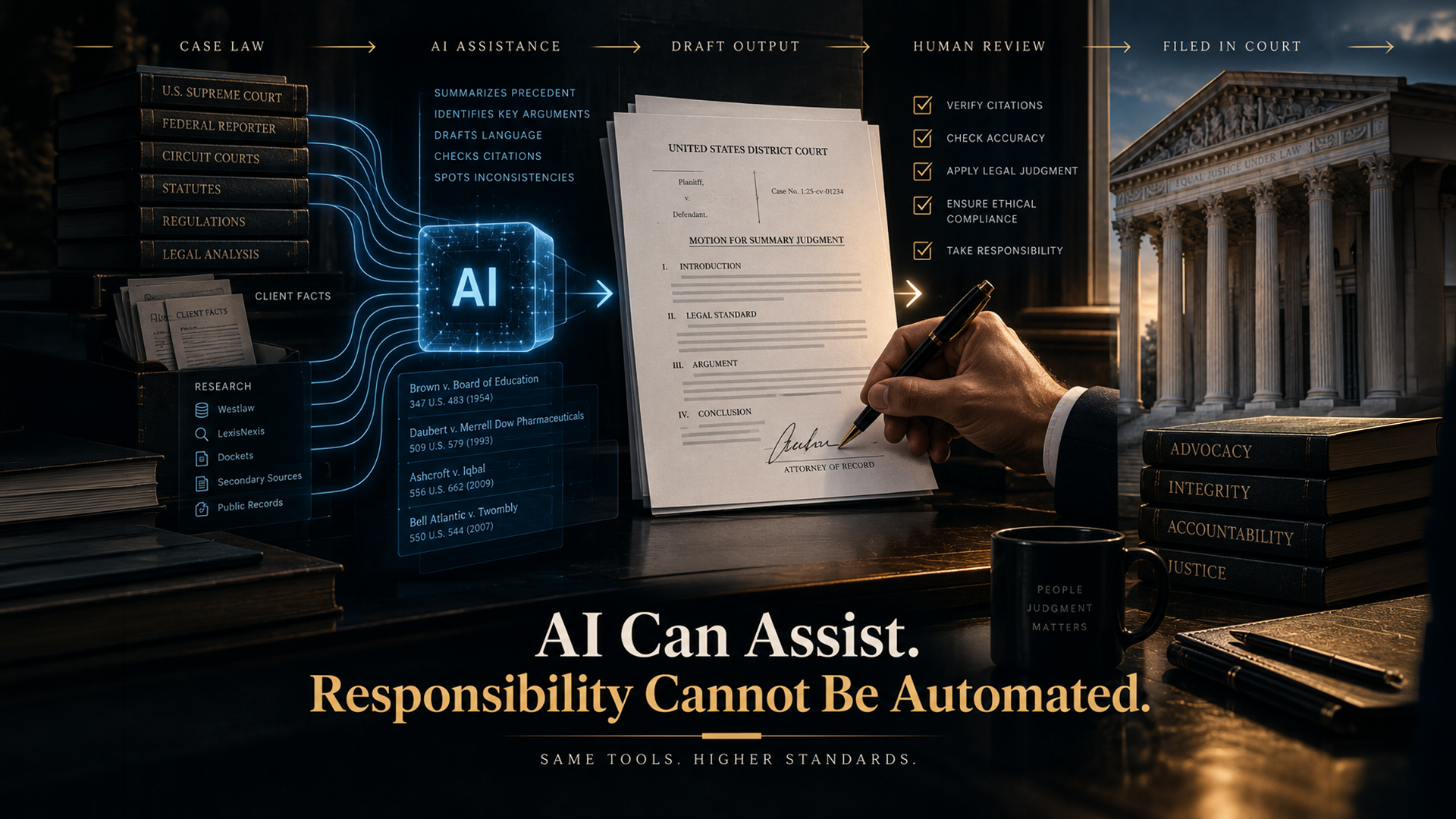
The practical point is broader than any one product. Lawyers can delegate tasks. They can use increasingly sophisticated technology to accelerate research and drafting. What they cannot delegate is the professional judgment represented by their signature.
The Second Event: What the Lawyer Does After the Error Is Found
The most consequential development in the recent cases may be the courts’ increasing focus on what happens after the hallucination is discovered. Fletcher is a prime example. The Fifth Circuit found that counsel had used AI to draft a substantial portion, if not all, of a reply brief and had failed to verify it. The court identified fabricated quotations and additional material misrepresentations and imposed a $2,500 personal sanction.
But the court’s reasoning did not stop with the defective brief. It found that counsel was not forthcoming in responding to the show-cause order. That lack of candor mattered to the court’s exercise of its disciplinary and inherent authority. The opinion contrasted that conduct with the lawyer who recognizes an error, apologizes, corrects the record, and takes responsibility.
The Ninth Circuit drew the distinction even more sharply in Lnu. There, the lawyers initially attributed nonexistent authorities to typographical or copy-and-paste errors and resisted acknowledging AI’s role. The court stated that when an attorney learns of a material error in a filing—including a generative-AI hallucination—the attorney should promptly alert the court and opposing counsel and disclose the source of the problem.
The sanctions reflected the seriousness of the court’s candor concerns: $2,500 against each attorney, six-month suspensions from Ninth Circuit practice, notice obligations, disciplinary referrals, and a two-year requirement for specified AI-related certifications in future filings. The panel expressly stated that the gravity of the discipline was attributable to the repeated failure of candor.
The Third Circuit’s published discipline decision in McCarthy v. United States Drug Enforcement Administration, 171 F.4th 245 (3d Cir. 2026), provides a useful counterpoint. Counsel relied on summaries of agency decisions supplied by a nonlawyer; the summaries had been generated using AI. Seven of eight authorities were inaccurately described, and one did not exist. The court found a competence violation and imposed a public reprimand. It credited counsel’s eventual contrition and corrective efforts, although it also noted that meaningful remediation came only after judicial intervention. The court warned that future violations, now that the circuit had spoken, could draw monetary sanctions.
The principle running through these cases is increasingly hard to miss: correction is not merely damage control. It is part of the lawyer’s professional obligation.
Whiting Shows How Far the Sanctions Can Go
The Sixth Circuit’s decision in Whiting v. City of Athens, Tennessee, 170 F.4th 455 (6th Cir. 2026), demonstrates what can happen when inaccurate briefing is paired with a confrontational response to the court’s inquiry.
The court identified more than two dozen fake citations and factual misrepresentations. Its show-cause order directed counsel to explain, among other things, who prepared the briefs, whether generative AI was used, and how the citations had been checked. Rather than answer those directives, counsel characterized the order as void, harassment, and the product of improper ex parte communications.
The Sixth Circuit ordered the lawyers jointly and severally to reimburse appellees’ appellate attorney fees, imposed double costs, and separately ordered each lawyer to pay a $15,000 punitive sanction. The court relied on Rule 38 and its inherent authority.
The lesson is not that every AI citation error produces a five-figure sanction. It is that once a court discovers fabricated authority, the credibility problem quickly becomes larger than the citation itself. The court must verify the filing, opposing counsel must spend time unraveling it, and every other representation in the brief becomes harder to trust.
Lichfield: Correct It Explicitly and Without Prompting
The Tenth Circuit’s July 2026 decision in Lichfield v. Kubler, 183 F.4th 1248 (10th Cir. 2026), shows the other end of the spectrum.
The opening brief cited an authority that did not exist and characterized two real cases in ways unsupported by the opinions. After the appellees identified the errors, the reply acknowledged “several citation errors,” but counsel did not file a corrected brief. A notice of errata arrived only after the court raised the problem at oral argument.
The Tenth Circuit declined to impose sanctions, but it held that the opening brief failed to fully comply with the court’s reasonable-inquiry rule and gave an unusually clear instruction for future cases: a fabricated or hallucinated citation should be corrected “explicitly and without prompting.” The court also emphasized that counsel remains responsible for ensuring that representations are supported by law and the record “no matter the technology used to create them.”
That may be the most useful operational rule in the 2026 cases. Do not wait for the next brief. Do not bury the correction in a footnote. Do not force the court to ask at argument. Correct the docket directly.
The Cases Are Producing a Sanctions Spectrum, Not a Per Se Rule
District courts are developing the same distinction. In Benjamin v. Costco Wholesale Corp., 779 F. Supp. 3d 341 (E.D.N.Y. 2025), the court imposed a $1,000 sanction—lower than in many comparable cases—in part because of counsel’s candor and sincere regret. By contrast, Jimenez-Fogarty v. Fogarty, 831 F. Supp. 3d 253 (S.D.N.Y. 2026), imposed a $2,500 Rule 11 sanction and notification requirements after counsel submitted numerous nonexistent cases and then failed adequately to explain the drafting process.
The sanction amount is not the most important point. The emerging pattern is. Courts are looking not only at the number of hallucinations, but at the lawyer’s verification process, the stage at which the problem is discovered, the speed and completeness of the correction, the lawyer’s candor, and the remedial measures taken afterward.
That is a much more useful framework for firms than a categorical “AI permitted/AI prohibited” policy. It focuses on the conduct the courts actually care about.
The Harder Question: What Happens When the Error Comes From Chambers?
The next phase of this debate will not concern lawyers alone. Jackson Federation of Teachers v. Fitch, 799 F. Supp. 3d 571 (S.D. Miss. 2025), arose from a challenge to Mississippi legislation concerning diversity, equity, and inclusion programs. The reported district-court opinion confirms that U.S. District Judge Henry T. Wingate entered a temporary restraining order on July 20, 2025, and that the TRO was “revised and corrected” three days later.
The reported opinion does not explain why. The AI-specific facts come from the later public record, not from 799 F. Supp. 3d 571. Judge Wingate subsequently told Senate Judiciary Committee Chairman Charles Grassley that a law clerk had used Perplexity as a drafting aid and that an early draft was docketed before completion of chambers’ normal review process, describing the episode as a lapse in human oversight. [Before publication: insert citation to Judge Wingate’s correspondence with Sen. Grassley.]
The issue then reached the Fifth Circuit in a different posture. In No. 25-60496, Mississippi asked the court of appeals not only to reverse a later preliminary injunction but also to reassign the case to another district judge. The Fifth Circuit heard oral argument on August 31, 2026. As of September 17, 2026, the court had not issued a decision resolving the appeal or the reassignment request.
The merits of that request are for the Fifth Circuit, and the mechanisms governing judicial conduct are obviously different from the rules governing advocates. Judges are not signing pleadings subject to Rule 11, and attorney-disciplinary rules do not apply to Article III judges in the same way they apply to members of the bar.
But the underlying institutional principle is difficult to cabin to one side of the bench. If a lawyer cannot outsource responsibility for a filed brief to an algorithm, a judicial system increasingly using the same technology will need procedures that preserve human responsibility for judicial work product as well. A litigant should be able to assume that a document carrying the authority of a federal court has been reviewed by the human decision-maker whose authority it invokes.
The Practical Rulebook Is Already Here
Lawyers do not need to wait for a uniform national AI rule. The cases already provide a workable operating framework:
- AI may assist; it may not replace professional judgment. The lawyer signing a filing remains responsible for every legal and factual representation in it, regardless of how the draft was produced.
- Verify primary authority yourself. Open the decision. Confirm that it exists. Read the relevant pages. Check the quotation and the proposition for which the case is cited. Verification by asking another generative-AI system is not verification.
- Supervise the entire workflow. Responsibility extends to work performed by associates, staff, contractors, nonlawyers, and technological tools. A sophisticated platform does not eliminate the duty of supervision.
- Treat discovery of a material AI error as a candor event. If fabricated authority, a false quotation, or a material misstatement reaches the docket, correct it promptly, explicitly, and transparently.
- Do not make the response worse than the original mistake. Mata, Fletcher, Lnu, McCarthy, Whiting, and Lichfield all demonstrate in different ways that what counsel does after learning of the problem can materially affect the court’s response.
The profession has spent several years debating whether artificial intelligence will fundamentally change the practice of law. It already has. Research is faster. Drafting can be faster. Junior work can be automated. New tools will continue to improve.
But the most important rule emerging from the federal courts is strikingly traditional. Lawyers may adopt new tools. They may automate portions of the process. What they cannot automate is responsibility.