
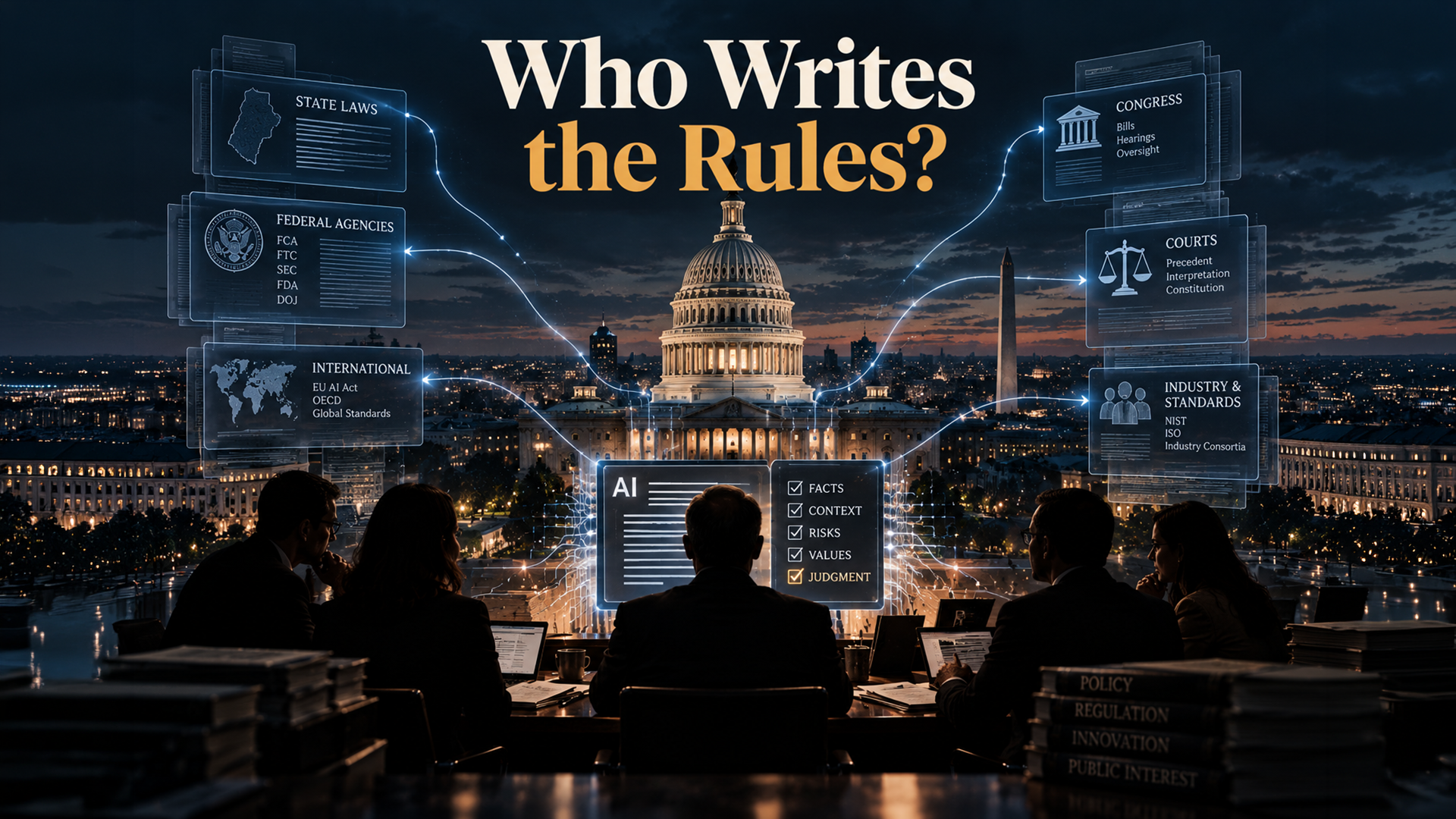
Who Writes the Rules? Previewing Holon’s AI Breakfast in Washington, DC
On October 22, Holon Law Partners brings its AI Breakfast Series back to Washington, DC, at a moment when the most important question in American AI policy is still unanswered: who writes the rules?
The AI Breakfast Series exists for exactly this moment. It is a small, standing forum that puts industry operators and policy leaders around one table in capital cities and strategic markets. We skip the demo theater and focus on the architecture, deployment, and governance questions that surface when AI meets real workflows, real regulators, and real people.
In DC, the conversation turns to four themes: current AI policy developments, how lawmakers understand AI, realistic approaches to governance, and AI’s impact in the marketplace. Here is a preview of what is on the table.
Policy developments: a federal framework, still unwritten
The United States still has no comprehensive federal AI statute, and the fight over whether one should displace state law remains open. The path so far has been a series of attempts rather than an outcome:
- May–July 2025: A 10-year moratorium on state AI enforcement passed the House in the reconciliation bill, then was stripped in the Senate by a 99–1 vote.
- December 11, 2025: Executive Order 14365, “Ensuring a National Policy Framework for Artificial Intelligence,” directed a DOJ litigation task force to challenge state AI laws, asked the FTC and FCC to develop preemption theories, and called for a proposed federal preemption bill.
- March 2026: The White House released legislative recommendations urging Congress to preempt state AI laws deemed unduly burdensome, while preserving room for generally applicable state laws and state procurement.
- June 4, 2026: A bipartisan House group released a discussion draft, the Great American AI Act. It would preempt state laws regulating how AI models are developed for three years, while leaving laws on how AI is deployed or used in place.
- July 2026: More than 200 state lawmakers and labor groups urged Congress to reject the draft’s preemption provision.
As of this writing, the draft has not been formally introduced, and public skepticism from House leadership about Congress leading on AI safety clouds its odds. The practical result: until a court, Congress, or a state itself acts, state AI laws remain in effect as written. For businesses, simplification is a possibility, not a plan.
How lawmakers understand AI
Much of the policy gridlock traces back to a definitional problem. “AI” is asked to mean a frontier model, a hiring algorithm, a chatbot, a medical device, and a marketing tool all at once, and each calls for a different regulatory lens.
The Great American AI Act draft illustrates the shift underway. Its central line is between developing a model and deploying one. That distinction matters: the risks of a model sitting in a lab differ from the risks of that model deciding who gets a loan or a job interview. Lawmakers who draw that line well tend to write rules that are enforceable. Those who don’t tend to write rules that are either unworkable or easy to route around.
Our April AI Breakfast in Miami surfaced a related insight. In regulated verticals such as law, accounting, and medicine, orchestrated, multi-component AI systems consistently outperform single monolithic models. The reason is not raw intelligence; it is auditability, scoping, and per-component governance. Policy that understands how AI is actually built and assembled can regulate at the right layer. In DC, we will ask how to close the gap between how AI works and how it is legislated.
Realistic governance: recalibration on both sides of the Atlantic
2026 has been a year of regulators adjusting ambitious frameworks to fit operational reality. Two examples stand out.
Colorado rewrote its AI Act rather than repealing it. On May 14, 2026, the legislature passed SB 26-189, which repeals and reenacts the Colorado AI Act. The rewrite replaces the original risk-management, impact-assessment, and algorithmic-discrimination duties with four narrower obligations: user notification, adverse-outcome disclosure, a data-correction right, and meaningful human review. The new effective date is January 1, 2027.
The EU slowed the clock on high-risk AI. Through the Digital Omnibus on AI, EU institutions reached a provisional agreement to defer high-risk obligations. Stand-alone Annex III systems, covering uses such as employment, credit, and education, move from August 2, 2026 to December 2, 2027. AI embedded in regulated products under Annex I moves to August 2, 2028. The Act’s risk-based structure and its transparency obligations remain largely intact.
The lesson is not that governance is retreating. It is that durable governance is narrower, more operational, and more focused on human oversight than first drafts. Meanwhile, enforcement keeps converging: the FTC applies Section 5 across AI, privacy, advertising, and ecommerce at once, and EU data protection authorities oversee both GDPR and AI Act compliance. Companies that build one integrated compliance architecture, rather than parallel programs, are best positioned for whichever rulebook arrives.
AI’s impact in the marketplace
The AI transactions crossing our desks in 2026 look less like SaaS subscriptions and more like regulated infrastructure procurement. That shift changes what clients need from contracts, diligence, and governance.
Three questions now come up in nearly every deal and deployment:
Where does the model live, and who can see what flows into it? Data residency, training-data provenance, and access controls have become core commercial terms.
When intelligence is distributed across parties, who is responsible when something goes wrong? Allocation of liability across model providers, integrators, and deployers is still being worked out in contracts long before courts weigh in.
Can the system be audited? Buyers, investors, and regulators increasingly expect documented human oversight and clear lines of accountability.
These are not abstract policy questions. They shape valuations, indemnities, and go-to-market timelines today, especially in employment, healthcare, financial services, defense, and other regulated sectors where AI’s compliance surface is widest.
The larger human-machine picture
Preemption, compliance deadlines, and contract terms are the visible layer. Beneath them sits a larger question: what role do we want people to play in systems that increasingly decide alongside them?
It is telling that the most durable governance ideas of 2026 share a common thread. Colorado’s rewrite centers meaningful human review. The EU framework keeps human oversight at the heart of high-risk AI. Orchestrated AI architectures earn trust in regulated industries precisely because humans can see and govern each component. The policy conversation is converging, slowly, on the human in the loop.
That is why we take a holistic view at the AI Breakfast table, and why Holon is investing beyond client work. At the October 22 breakfast, we will announce projects Holon is incubating, including a new Washington think tank dedicated to human-centric AI policy. Its aim is to give lawmakers, operators, and the public a shared, practical vocabulary for governing AI in service of people.
Join us at the table
Holon Law AI Breakfast: Washington, DC Thursday, October 22, 2026 · 8:00 a.m.
The series is convened by Eric Postow, Managing Partner, Chief Strategy Officer, and Co-Chair of Holon’s Emerging Technologies Group. Holon’s Emerging Technologies Group advises clients at the convergence of AI governance, privacy, cybersecurity, employment, healthcare, and regulated industries, with a team that combines federal regulatory experience, in-house technology leadership, and hands-on machine learning expertise.
Seating is limited to keep the conversation substantive. To request a seat or join the AI Breakfast Series newsletter, email AIBreakfast@holonlaw.com.
Interested in co-sponsoring? We welcome organizations that share our commitment to thoughtful, human-centric AI policy. To discuss co-sponsorship of the DC breakfast, please reach out to epostow@holonlaw.com.
This post is provided for general informational purposes only and does not constitute legal advice or create an attorney-client relationship. AI law is changing rapidly; developments described here are current as of early October 2026.


