
Defining Super Intelligence: Why the United States Must Lead in Law
By Eric Postow, Chief Strategy Officer, Holon Law Partners
On September 29, 2026, President Trump signed Executive Order 14434, “Inaugurating the Era of Super Intelligence,” published in the Federal Register on October 2. The order directs executive departments and agencies, to the maximum extent permitted by law, to use “Super Intelligence” and “SI” in place of “Artificial Intelligence” and “AI” in official correspondence, public communications, websites, reports, and policy documents. It applies prospectively, so previously issued regulations, Presidential actions, contracts, and grants remain as written. For now, the order defines Super Intelligence by reference to the existing statutory definition of artificial intelligence at 15 U.S.C. § 9401(3), which describes a machine-based system that can, for a given set of human-defined objectives, make predictions, recommendations, or decisions influencing real or virtual environments, using machine and human-based inputs to perceive those environments, abstract them into models through automated analysis, and use model inference to formulate options for information or action.
The reaction has been swift, and a good portion of it has been dismissive. Some commentators have called the order a rebrand, a marketing overlay, or a semantic trick that attaches an aspirational name to existing software. Their objection draws on the academic literature, where superintelligence, following Nick Bostrom’s widely cited formulation, refers to an intellect that greatly exceeds human cognitive performance in virtually all domains of interest, including scientific creativity, general wisdom, and social skills. Researchers in that tradition treat such a system as hypothetical, and they worry that applying the term to current tools will inflate public expectations while obscuring the ordinary failures of ordinary systems.
That concern about precision is fair, and it is exactly why the semantic reading of the order is mistaken. The order itself treats the current equivalence as temporary. Section 3(a) provides that the interim definition governs only unless and until it is superseded by subsequent Presidential action or by an Act of Congress. Section 3(b) then directs the Assistant to the President for Science and Technology to submit proposed legislative language establishing a federal definition of Super Intelligence that reflects the capabilities described in Section 1 of the order. That proposal must assess whether and to what extent the new definition should modify, expand upon, or supersede the existing statutory definition of artificial intelligence, recommend conforming amendments to existing statutory references, and identify any further executive action needed to implement it. A cosmetic change in vocabulary would require none of this. The order sets in motion a process to write a new legal category into federal law.
The capabilities the order points to are telling. Section 1 states that today’s frontier systems do much more than imitate or automate discrete aspects of human intelligence, and that they increasingly amplify human ingenuity across science, medicine, and nearly every other domain of human endeavor. Read in that light, artificial intelligence describes the tools we have built, while Super Intelligence describes what those tools are becoming as they compound in capability and integrate into the institutions that govern daily life. The academic definition and the federal one are less in conflict than they appear, since both are concerned with a trajectory, and the open question is where along that trajectory the law should begin to recognize something new.
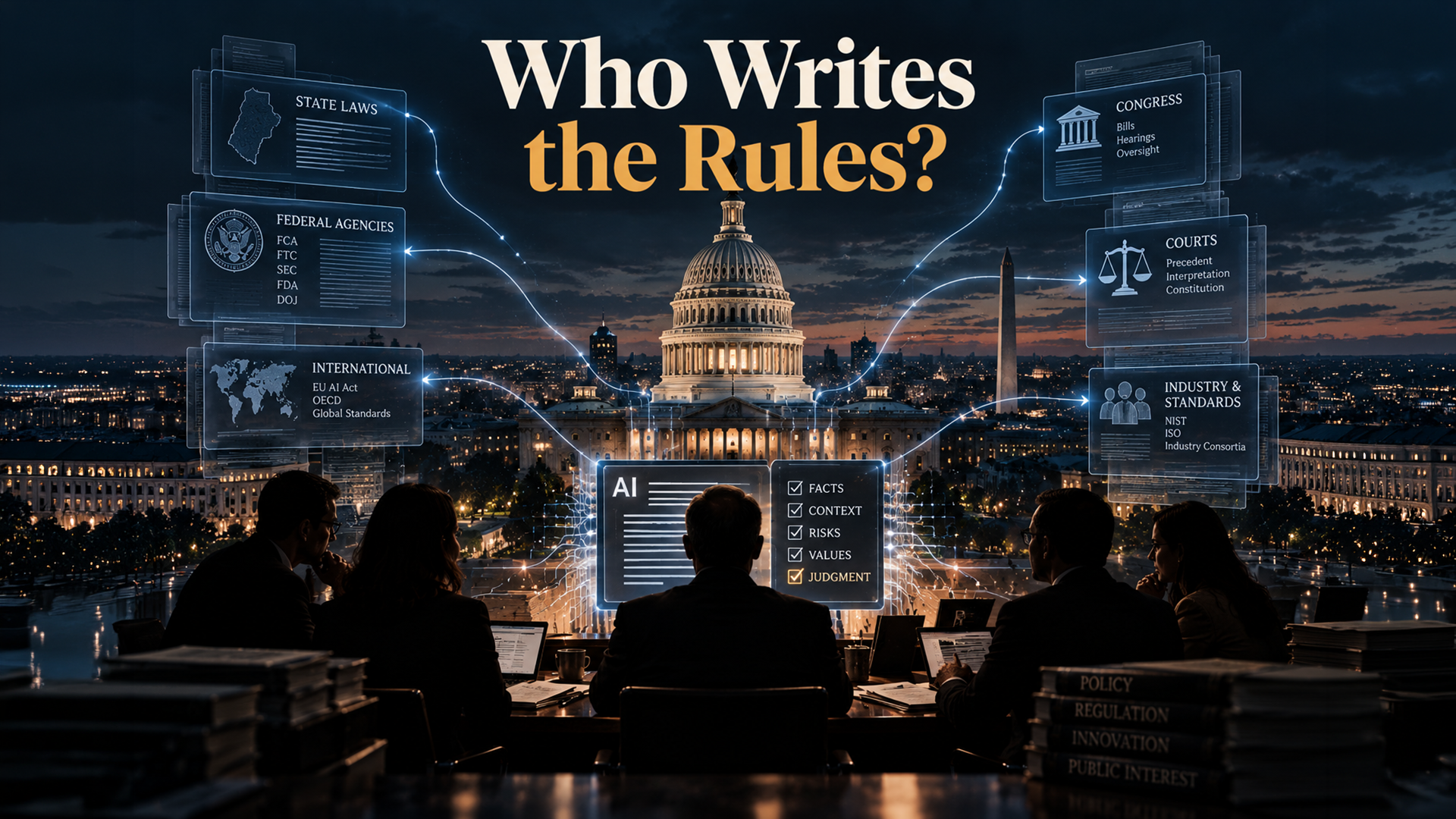
That question matters because definitions in statute carry consequence. A definition determines which systems fall within regulatory jurisdiction, which obligations attach to developers and deployers, how liability is allocated when automated systems cause harm, and what the government buys and how it evaluates what it buys. Whoever writes the definition sets the boundaries of oversight for a generation of technology, and a definition drawn too broadly or too narrowly will be difficult to correct once agencies, courts, and contracts have built around it.
The rest of the world is making its own choices. China has reportedly followed the American lead in adopting “super intelligence” in state guidance, framing such systems as infrastructure that must remain “safe, reliable, and controllable” under state monitoring and algorithm registration. The European Union has declined the shift and continues to rely on the AI Act, which defines a general-purpose AI model as one that displays significant generality and can competently perform a wide range of distinct tasks across downstream applications. The United Kingdom has focused on “frontier AI,” which its government has described as highly capable general-purpose models that can perform a wide variety of tasks and match or exceed the capabilities of today’s most advanced systems. Even within the federal government, NASA has acknowledged that no single simple definition captures the range of what these systems can do. Each approach reflects a governing philosophy, whether centralized control, risk-tiered market regulation, or empirical evaluation of emerging capability, and the American definition will reflect one as well.
This is the opportunity in front of us. The United States can establish a definition that tracks real capability thresholds rather than a fixed snapshot of today’s technology, preserves the principle that these systems operate toward human-defined objectives with human accountability, and remains durable as capabilities continue to advance. Getting it right will require lawyers, technologists, ethicists, and policymakers to bring their collective imagination to a question that until recently belonged to philosophy.
The timeline is short. Under Section 3(b), the proposed legislative language is due to the President within 60 days of September 29, 2026, which places the deadline on or before November 28, 2026. That submission goes first to the President, and any lasting definition will ultimately depend on Congress. Holon Law Partners will continue to track the proposal, the conforming amendments it recommends, and how other governments respond as the definition of Super Intelligence moves from executive order toward statute.