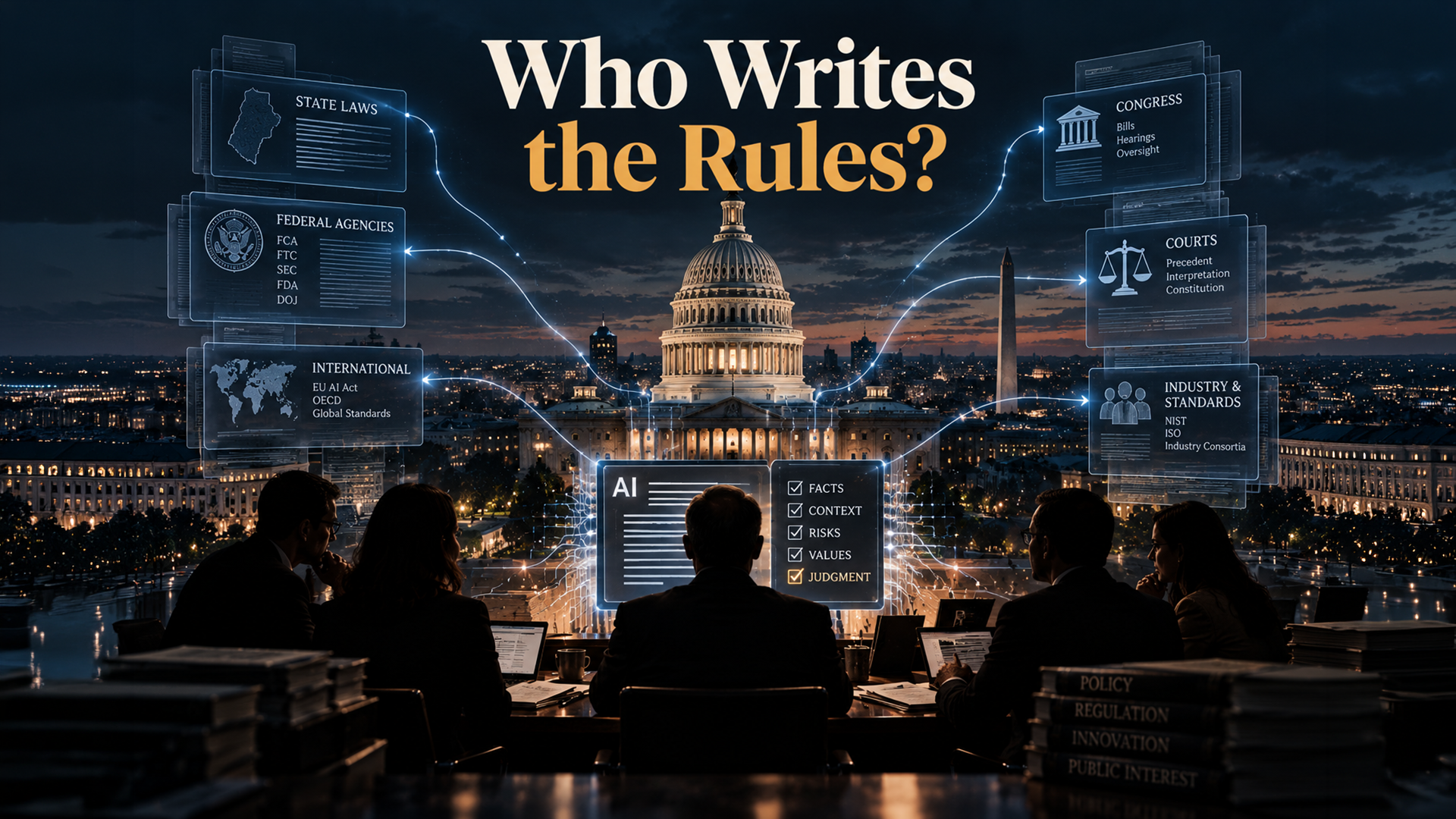

The AI Rulebook Is Going Local
By Jason H. Ehrenberg, Holon Law Partners
What Litigators Should Know in Connecticut, D.C., Virginia, North Carolina, Maryland, New York, and Colorado
Federal courts are developing a common law of artificial-intelligence-assisted advocacy. But for practicing lawyers, an equally important development is occurring closer to home. State courts, state bars, and federal district courts are beginning to regulate AI use through a patchwork of reported decisions, ethics opinions, practice-book provisions, court-wide orders, and professional-responsibility rules.
The practical rulebook increasingly depends on where the lawyer practices. Connecticut has adopted express statewide verification duties backed by trial- and appellate-level sanctions. The District of Columbia now has both a published Court of Appeals order and a developing line of D.D.C. decisions. Virginia has a published appellate sanctions decision and federal authority. North Carolina has a federal district-wide order that reaches filings, evidence, and discovery. Maryland now has directly on-point state appellate authority. New York has the deepest state and federal sanctions record of the jurisdictions surveyed. Colorado has both state appellate guidance and binding Tenth Circuit authority.
The jurisdictions are taking different routes, but they are converging on a familiar principle: AI may assist the lawyer, but it does not assume the lawyer’s professional responsibility. Verification, confidentiality, supervision, candor, reasonable inquiry, and independent professional judgment remain human obligations.
Connecticut: Verification Is Now Embedded in the Practice Book
Connecticut has moved beyond advisory guidance. Effective June 23, 2026, Practice Book § 4-9, “Generative Artificial Intelligence Compliance,” requires a person who uses generative AI in creating or editing a court filing to independently verify citations, legal authorities, and evidence produced by the technology. Responsibility rests with the filer; the court and clerk are not charged with policing compliance.
The consequence language is unusually important. Section 4-9 states that failure to verify AI-generated material may result in sanctions, including nonsuit or default judgment. Connecticut therefore treats verification not merely as best practice but as a procedural obligation capable of affecting the merits of the client’s case.
Two companion provisions make the structure even clearer. Practice Book § 4-2(b), amended effective June 23, 2026, folds § 4-9 compliance into the certification made by signing a pleading, motion, objection, or request. On the appellate side, Practice Book § 85-2(11), amended effective July 14, 2026, expressly identifies failure to independently verify AI-produced citations under §§ 4-9 and 62-6(d) as sanctionable. Available appellate consequences include suspension of filing privileges, fines, costs, and attorney’s fees.
Connecticut’s federal courts had already supplied a useful analytical framework. In Andre v. Warden, FCI Danbury, 827 F. Supp. 3d 294 (D. Conn. 2025), the court focused on two recurring considerations: human verification of authority and “candor and correction” after an error is discovered. Prompt disclosure weighs heavily in mitigation; concealment or minimization aggravates the problem. And because Connecticut lies within the Second Circuit, Park v. Kim, 91 F.4th 610 (2d Cir. 2024), provides the appellate baseline that Rule 11 requires counsel, at a minimum, to confirm that cited authority actually exists.
Connecticut’s approach is therefore unusually complete: the signature, the AI-verification duty, and the sanctions mechanism are linked. A lawyer who uses AI in a Connecticut filing should treat primary-source verification as part of the act of signing the paper.
District of Columbia: Ethics Opinion 388, Douglas, and a Developing D.D.C. Line
The District of Columbia now offers one of the more complete jurisdiction-specific frameworks for lawyers using generative AI: a formal ethics opinion addressing the technology across client matters, a published D.C. Court of Appeals order involving fictitious AI-generated authority, and a growing D.D.C. sanctions line.
D.C. Bar Legal Ethics Opinion 388, published in April 2024, begins from a deliberately traditional premise: new technology does not alter lawyers’ fundamental ethical obligations to clients or courts. The opinion identifies Rules 1.1, 1.2, 1.5, 1.6, 1.16, 3.3, 3.4, 5.1, 5.3, and 8.4 as potentially implicated by generative-AI use. Its central competence rule is practical rather than technical. A lawyer need not be a programmer, but before using a particular generative-AI product the lawyer should have a reasonable and current understanding of how it works, its limitations, its risk of hallucination, its treatment of confidential information, and whether its output is reliable for the task at hand.
For legal research and drafting, Opinion 388 is explicit that general-purpose generative AI is not a substitute for traditional fact- and cite-checking. A lawyer must have a reasonable basis for trusting the output or must review and validate it before incorporating it into client work or relying on it in a legal proceeding. The opinion uses Mata v. Avianca, Inc., 678 F. Supp. 3d 443 (S.D.N.Y. 2023), as its object lesson: the ethical problem was not merely that the lawyer used ChatGPT, but that he misunderstood the tool, treated it as a reliable research database, and failed to verify the authorities it generated.
Opinion 388 is equally important outside the hallucination context. On confidentiality, it directs lawyers to understand whether a product retains prompts or outputs, whether provider personnel or third parties can access them, and whether the lawyer’s interactions may affect responses later supplied to other users. Client confidences, secrets, and lawyer mental impressions may therefore present Rule 1.6 and work-product risks. If a lawyer cannot be reasonably satisfied that the system will protect client information, the lawyer should not place that information into the system. The opinion notes that stronger contractual protections or zero-data-retention arrangements may address some of those concerns.
The opinion also makes AI governance a supervision issue. Under Rules 5.1 and 5.3, managers and supervising lawyers should take reasonable measures to ensure that lawyers and nonlawyers using generative AI do so consistently with the Rules of Professional Conduct. That may mean firm-level vetting of approved tools, confidentiality requirements, verification procedures, and restrictions on unscreened products. In other words, AI risk is not only a matter of individual lawyer competence; it is increasingly a law-firm management issue.
For litigation, Opinion 388 ties AI use directly to Rules 3.3 and 3.4. False factual or legal assertions, fabricated citations, false evidence, and violations of tribunal-specific AI orders can implicate candor and fairness obligations. The opinion also emphasizes the continuing duty to correct a false statement of material fact or law previously made to a tribunal when Rule 3.3 requires correction. That principle fits closely with the later federal and appellate cases treating post-error candor as a separate event from the original mistake.
Opinion 388 reaches two additional areas that litigation-focused discussions often miss. First, hourly billing remains hourly billing: when AI reduces the time required to complete a task, a lawyer billing solely by time may charge only for time actually spent, although agreed out-of-pocket AI expenses may be passed through where the fee arrangement permits. Second, lawyers should consider whether particular prompts, outputs, or other AI interactions belong in the client file under Rule 1.16(d), especially where they reflect substantive analysis, strategy, or work product.
The D.C. Court of Appeals has now supplied the enforcement counterpart to that ethics framework. In Douglas v. Deutsche Bank National Trust Co., No. 24-CV-1099, 2026 WL 2603056 (D.C. Sept. 3, 2026), the court addressed an appellee brief containing four nonexistent authorities. Counsel acknowledged using Google’s generative-AI search functionality and acknowledged that the authorities had not been verified before filing. The court struck the brief and referred the matter to the Office of Disciplinary Counsel.
Douglas is important not only because of the sanction. Senior Judge Glickman’s concurrence warned that fabricated cases may be the easiest AI error to detect; distortion of real authority can be less conspicuous and more dangerous. The concurrence also flagged the supervisory dimension of AI use, including the responsibility of senior lawyers where training and oversight are deficient – a point that closely tracks Opinion 388’s treatment of Rules 5.1 and 5.3.
The federal district court has developed a complementary line. In Williams v. Capital One Bank, N.A., 2025 WL 843285 (D.D.C. Mar. 18, 2025), the court rejected the filing of nonexistent authority apparently produced through an AI tool, emphasizing that nonexistent cases are unacceptable whether AI-assisted or not. In N-Bar Trade, Inc. v. Amazon.com Services LLC, 807 F. Supp. 3d 11 (D.D.C. 2025), nonexistent quotations implicated Rule 11(b)(2) and D.C. Rule of Professional Conduct 3.3(a)(1). Ekeocha v. U.S. Department of State, 2025 WL 3228063 (D.D.C. Nov. 19, 2025), applied the same general framework and warned of a show-cause response if the problem returned.
Zhang v. National Public Radio, Inc., 2025 WL 4033858 (D.D.C. Dec. 18, 2025), shows the monetary consequence. Counsel’s opposition contained two fictitious cases and eight mischaracterized citations; the court struck the brief and required counsel to pay the fees NPR incurred preparing its reply.
Taken together, Opinion 388, Douglas, and the D.D.C. decisions make the District’s rule unusually concrete. AI may be used, but lawyers must understand the tool sufficiently to use it competently, protect client information, supervise its use, verify substantive output, bill accurately, and satisfy duties of candor and fairness when AI-assisted work reaches a tribunal.
Virginia: A Published Appellate Sanction and Federal Warnings
Virginia now has directly on-point state appellate authority. In LPC Commercial Services, LLC v. Ar-Razzaaq Properties, LLC, No. 1407-25-4, 2026 WL 2481676 (Va. Ct. App. Aug. 25, 2026), the Court of Appeals confronted an appellee brief containing 26 purported direct quotations from Virginia cases. None was an exact match; one differed by a word, while the other 25 ranged from inaccurate paraphrases to wholly invented or “hallucinated” language.
The court grounded its analysis in Virginia Code § 8.01-271.1. Subsection (B) embodies the reasonable-inquiry certification attached to a signed paper, and subsection (D) makes an appropriate sanction mandatory when the statute is violated. Because the record did not show a monetary loss warranting a fee award, the court ordered counsel to complete a continuing-legal-education course relating to AI or appellate practice within six months.
LPC is especially useful because it focuses on a risk more subtle than an invented case name. A real case paired with a fabricated quotation can look plausible enough to survive a superficial check. Verification therefore means opening the authority, comparing the purported quotation with the opinion, and confirming that the case actually stands for the proposition asserted.
The court also framed the issue through Virginia Rules of Professional Conduct 1.1, 1.3, 3.1, and 3.3 and cited Darius K. Davenport, Sr.’s June 2026 Virginia Lawyer article, “A Message for Virginia Litigators: Competence is Foundational,” on the lawyer’s verification obligation.
Federal authority points in the same direction. In Iovino v. Michael Stapleton Associates, Ltd., 2024 WL 3520170 (W.D. Va. July 24, 2024), Judge Cullen issued a Rule 11(c) show-cause order over fabricated cases and quotations. A related appeal was later dismissed for lack of jurisdiction. The important point for AI practice is the district court’s treatment of apparently invented authority as a Rule 11 problem, not as a technological curiosity.
Virginia also has a pending professional-responsibility development. Proposed Legal Ethics Opinion 1902 addresses opposing counsel’s responsibilities when confronted with a filing containing AI-hallucinated misstatements. LPC itself corroborates the proposal in a footnote. Because the opinion remained proposed as of this article’s date, it should not be described as binding.
North Carolina: Court-Wide Certification Through the Act of Filing
North Carolina’s strongest presently verified authority is a court-wide federal order. In In re Use of Artificial Intelligence, No. 3:24-mc-00104 (W.D.N.C. July 29, 2026), the Western District of North Carolina imposed district-wide requirements grounded in Rule 11 and the duty of candor.
The order applies to attorneys and self-represented litigants alike. Any filing operates as a certification that cited authorities actually exist and that citations and quotations have been accurately verified by a human. The order therefore rejects the idea that an AI-specific certificate is necessary; the professional commitment arises from filing the document itself.
The order also reaches beyond briefs. Its verification requirements extend to evidence and other materials, including expert reports, transcripts, demonstratives, media, and discovery responses. It imposes an ongoing duty of technological competence, not merely a one-time filing check.
The potential remedies are correspondingly broad: striking filings, show-cause orders, monetary sanctions, dismissal or striking an answer where authorized, disciplinary referral, and restrictions on practice in the district. The July 2026 order expressly superseded the district’s June 18, 2024 standing order and eliminated the separate AI certificate.
North Carolina State Bar 2024 Formal Ethics Opinion 1 also addresses generative AI. Because the full text is not included in the present source set, this article does not attribute specific holdings to it. The governing professional duties nevertheless remain familiar: competence, confidentiality, supervision, and reasonable fees.
Maryland: Mezu Supplies Direct State Appellate Authority
Maryland’s strongest authority is now a decided state appellate case, not merely general ethics guidance.
In Mezu v. Mezu, 267 Md. App. 354, 346 A.3d 181 (Md. App. Oct. 29, 2025), counsel filed a brief containing fabricated AI-generated citations. The Appellate Court of Maryland referred counsel to the Attorney Grievance Commission. The opinion tied the misconduct to Maryland Rule 1-311(b), the certification attached to an attorney’s signature, and to Maryland Attorneys’ Rules of Professional Conduct 19-301.1 (competence), 19-303.1 (meritorious claims and contentions), and 19-305.3(b) (responsibilities regarding nonlawyer assistance).
Mezu is useful because it translates AI misuse into familiar Maryland doctrine. Competence includes reading the authority one cites. Signature responsibility cannot be outsourced to a technological tool. And supervision principles can matter when the flawed work originates outside the lawyer’s own direct drafting.
The court surveyed the developing national sanctions record but did not impose a monetary sanction because none had been requested. Instead, it chose a disciplinary referral. The case was later distinguished by Neal v. Frayer (D. Md. Nov. 17, 2025), so its precise reach should be read with that later treatment in mind before publication or reliance beyond Mezu’s core facts.
Maryland’s Standing Committee on Rules of Practice and Procedure has also recommended an amendment to Maryland Rule 1-311 addressing hallucinated or fabricated citations, with the proposal dated March 16, 2026. That pending development reinforces the same basic architecture: the lawyer’s signature is the point at which technological assistance becomes professional responsibility.
New York: The Deepest State and Federal Sanctions Record
New York remains the leading laboratory for AI-sanctions doctrine among the jurisdictions surveyed.
Mata v. Avianca, Inc., 678 F. Supp. 3d 443 (S.D.N.Y. 2023), established the modern cautionary tale. Counsel submitted nonexistent decisions generated through ChatGPT and then compounded the original failure after questions were raised. The court imposed a $5,000 Rule 11 sanction and emphasized that prompt acknowledgment would have materially changed the record.
The Second Circuit supplied the appellate baseline in Park v. Kim, 91 F.4th 610 (2d Cir. 2024). Rule 11 requires, at a minimum, confirming that an authority exists before citing it. Park matters in both New York and Connecticut and has become one of the cleanest statements of the proposition that professional responsibility cannot consist of trusting generated text because it looks like law.
The district courts then developed a sanctions spectrum. In Benjamin v. Costco Wholesale Corp., 779 F. Supp. 3d 341 (E.D.N.Y. 2025), the court imposed a $1,000 sanction and treated counsel’s candor and remorse as mitigating. In Jimenez-Fogarty v. Fogarty, 831 F. Supp. 3d 253 (S.D.N.Y. 2026), the court imposed a $2,500 sanction and notification requirements after numerous nonexistent authorities were followed by an inadequate explanation and minimization of the problem.
By 2026, the New York Appellate Division had added a substantial state-law body of authority. In Deutsche Bank National Trust Co. v. LeTennier, 251 A.D.3d 97, 250 N.Y.S.3d 260 (3d Dep’t 2026), the court imposed a $5,000 sanction under 22 NYCRR 130-1.1 after counsel submitted at least 23 fabricated authorities across five filings and continued citing nonexistent cases after being put on notice.
Landberg v. City of New York, 2026 WL 1792016 (2d Dep’t June 23, 2026), imposed $8,000 against counsel, together with a firm sanction, after briefing included nonexistent cases and fabricated quotations attributed to the New York Court of Appeals. The response at oral argument aggravated the court’s concerns. Julien v. Arthur, 260 N.Y.S.3d 344 (2d Dep’t 2026), applied the same principle to a self-represented litigant, holding that pro se status did not excuse failure to verify AI-generated citations and imposing a $250 sanction.
Matter of Zareh, 251 A.D.3d 73, 250 N.Y.S.3d 534 (1st Dep’t 2026), connects hallucinated legal research to attorney discipline: the court imposed public censure as reciprocal discipline for presenting an unreviewed AI-drafted brief. At the trial level, Grymes Development Co. v. Fodera, 88 Misc. 3d 767 (Sup. Ct. Richmond Cnty. 2025), imposed a $2,000 sanction plus opposing fees and drew on New York City Bar Formal Opinion 2024-5 and the New York State Bar Association’s AI Task Force work.
New York City Bar Formal Opinion 2024-5 (Aug. 7, 2024) addresses generative-AI ethics. Because the full text is not included in the present source set, this article does not attribute granular holdings to the opinion.
New York’s broader lesson is no longer simply “do not hallucinate cases.” The state and federal cases now demonstrate a sanctions continuum in which the number of false authorities matters, but so do notice, repetition, human verification, candor, and the speed and completeness of correction.
Colorado: Al-Hamim and Binding Tenth Circuit Guidance
Colorado has relevant authority at both the state appellate and federal appellate levels.
In Al-Hamim v. Star Hearthstone, LLC, 2024 COA 128, 564 P.3d 1117 (Colo. App. Dec. 26, 2024), a self-represented litigant filed an opening brief containing generative-AI hallucinations. The court declined severe sanctions in light of the novelty of the issue and the litigant’s candor, but rejected the request to file an amended brief and warned that future filings by lawyers or self-represented parties containing AI hallucinations may draw sanctions. The December 26, 2024 date corrects the date used in the prior draft.
Federal practitioners in Colorado also have binding Tenth Circuit guidance. In Lichfield v. Kubler, 183 F.4th 1248 (10th Cir. 2026), the opening brief cited a nonexistent authority and mischaracterized two real cases. The court declined sanctions but concluded that counsel had not fully complied with the circuit’s reasonable-inquiry requirement. Its operational instruction is especially useful: a hallucinated citation should be corrected explicitly and without waiting for the court to force the issue.
Together, Al-Hamim and Lichfield illustrate both sides of the developing sanctions analysis. Courts may mitigate consequences when the issue is novel and the filer is candid, but the expectation of verification is now clearly established and the correction duty is increasingly explicit.
The Common Rulebook Emerging Across the Seven Jurisdictions
Primary-source verification.
Confirm that a decision exists, open it, read the relevant portion, verify quotations, and confirm that the authority actually supports the proposition attributed to it. A second AI tool is not an independent source check.
Signature responsibility.
Connecticut’s Practice Book, Virginia Code § 8.01-271.1, Maryland Rule 1-311, Rule 11, and the North Carolina federal order all converge on the same point: once the lawyer signs or files the paper, the lawyer owns the legal and factual representations in it.
Candor and correction.
Andre, Mata, Benjamin, Douglas, LeTennier, Landberg, LPC Commercial Services, and Lichfield show in different ways that the response after discovery of an error can materially affect the court’s reaction. Correction should be prompt, explicit, and complete.
Supervision.
AI workflows implicate the same supervision concerns that arise when work is delegated to associates, paralegals, contractors, or other nonlawyers. Senior lawyers should know how AI-assisted work is generated, reviewed, and verified.
Confidentiality and client information.
Even where the immediate cases concern hallucinated citations, the professional-responsibility problem is broader. Before entering client information into an AI system, lawyers should understand retention, reuse, training, access, and contractual protections.
Court-specific rules.
A firm-wide AI policy is necessary but insufficient. Lawyers must check the rules, standing orders, practice-book provisions, and judge-specific requirements governing the particular court in which they are filing.
The Takeaway
The most important development is not that courts are banning generative AI. Most are not. Instead, courts are making explicit what professional responsibility has always assumed: the lawyer must understand enough about the method used to produce legal work to take responsibility for the result.
The state and local authorities now add important detail. Connecticut ties AI verification to the filer’s certification and appellate sanctions. D.C. has local appellate discipline and a growing D.D.C. line. Virginia has a published appellate sanction. North Carolina treats the act of filing as the certification. Maryland has direct state appellate authority. New York has developed a full sanctions spectrum. Colorado has state appellate and Tenth Circuit guidance.
The technologies are new. The duties – competence, reasonable inquiry, supervision, candor, confidentiality, and professional judgment – are not.
Artificial intelligence may assist the lawyer. It does not become the lawyer. And it does not sign the brief.
Selected Authorities
Connecticut: Conn. Practice Book §§ 4-2(b), 4-9, 85-2(11), 62-6(d); Andre v. Warden, FCI Danbury, 827 F. Supp. 3d 294 (D. Conn. 2025); Park v. Kim, 91 F.4th 610 (2d Cir. 2024).
District of Columbia: Douglas v. Deutsche Bank Nat’l Tr. Co., No. 24-CV-1099, 2026 WL 2603056 (D.C. Sept. 3, 2026); Williams v. Capital One Bank, N.A., 2025 WL 843285 (D.D.C. Mar. 18, 2025); N-Bar Trade, Inc. v. Amazon.com Servs. LLC, 807 F. Supp. 3d 11 (D.D.C. 2025); Ekeocha v. U.S. Dep’t of State, 2025 WL 3228063 (D.D.C. Nov. 19, 2025); Zhang v. Nat’l Pub. Radio, Inc., 2025 WL 4033858 (D.D.C. Dec. 18, 2025); D.C. Bar Legal Ethics Op. 388 (Apr. 2024).
Virginia: LPC Commercial Servs., LLC v. Ar-Razzaaq Props., LLC, No. 1407-25-4, 2026 WL 2481676 (Va. Ct. App. Aug. 25, 2026); Va. Code § 8.01-271.1; Iovino v. Michael Stapleton Assocs., Ltd., 2024 WL 3520170 (W.D. Va. July 24, 2024); Proposed Va. LEO 1902 (2026).
North Carolina: In re Use of Artificial Intelligence, No. 3:24-mc-00104 (W.D.N.C. July 29, 2026); N.C. State Bar, 2024 Formal Ethics Op. 1 (existence and AI subject matter corroborated; full text should be checked before quoting specific holdings).
Maryland: Mezu v. Mezu, 267 Md. App. 354, 346 A.3d 181 (Md. App. Oct. 29, 2025); Md. Rule 1-311(b); Md. Attorneys’ Rules of Prof’l Conduct 19-301.1, 19-303.1, 19-305.3(b); proposed amendment to Md. Rule 1-311 (Mar. 16, 2026).
New York: Mata v. Avianca, Inc., 678 F. Supp. 3d 443 (S.D.N.Y. 2023); Park v. Kim, 91 F.4th 610 (2d Cir. 2024); Benjamin v. Costco Wholesale Corp., 779 F. Supp. 3d 341 (E.D.N.Y. 2025); Jimenez-Fogarty v. Fogarty, 831 F. Supp. 3d 253 (S.D.N.Y. 2026); Deutsche Bank Nat’l Tr. Co. v. LeTennier, 251 A.D.3d 97, 250 N.Y.S.3d 260 (3d Dep’t 2026); Landberg v. City of New York, 2026 WL 1792016 (2d Dep’t June 23, 2026); Julien v. Arthur, 260 N.Y.S.3d 344 (2d Dep’t 2026); Matter of Zareh, 251 A.D.3d 73, 250 N.Y.S.3d 534 (1st Dep’t 2026); Grymes Dev. Co. v. Fodera, 88 Misc. 3d 767 (Sup. Ct. Richmond Cnty. 2025); N.Y.C. Bar Formal Op. 2024-5 (Aug. 7, 2024).
Colorado: Al-Hamim v. Star Hearthstone, LLC, 2024 COA 128, 564 P.3d 1117 (Colo. App. Dec. 26, 2024); Lichfield v. Kubler, 183 F.4th 1248 (10th Cir. 2026).
Author Bio
Jason H. Ehrenberg is a Limited Partner, Litigation Lead, and Head of the Employment Group at Holon Law Partners.
This article is provided for general informational purposes only and does not constitute legal advice. It does not create an attorney-client relationship with Holon Law Partners, LLP.