Who Owns a Letter? The WNBA’s “THE W” Application Draws a Trademark Challenge from the Cubs and Nationals
By HOLON LAW PARTNERS
A new TTAB opposition involving the WNBA, the Chicago Cubs, and the Washington Nationals is a reminder that even the simplest trademarks can carry complicated questions of scope, similarity, and brand overlap — and a useful case study for any organization building a trademark portfolio around a short, powerful mark.
A single letter may be one of the simplest trademarks imaginable. But simple does not mean unguarded.
On August 10, 2026, the Chicago Cubs and Washington Nationals jointly filed an opposition before the U.S. Trademark Trial and Appeal Board (TTAB) challenging WNBA Enterprises, LLC’s application to register THE W for a broad range of apparel. The proceeding — Chicago Cubs Baseball Club, LLC and Washington Nationals Baseball Club, LLC v. WNBA Enterprises, LLC, Opposition No. 91309516 — puts three of professional sports’ most recognizable brands in direct conflict over what looks, at first glance, like the most basic building block available: the letter W.
It’s a deceptively rich dispute. Neither baseball club can claim ownership of the letter W in the abstract. Yet both have built substantial trademark portfolios around distinctive versions of W, including registrations covering apparel and other sports merchandise. The WNBA, for its part, is seeking THE W in standard characters meaning its application isn’t tied to any particular typeface, size, or color.
That combination elevates this beyond a simple “do the logos look alike” comparison. It’s a clear window into how trademark law draws boundaries around simple marks and a set of lessons every brand owner building around a short, memorable mark should take note of.
The Application
WNBA Enterprises filed Application Serial No. 99105898 on March 26, 2025, seeking registration of THE W for sports jerseys, jerseys being clothing, hooded sweatshirts, sweatshirts, caps, hats, shirts, T-shirts, cardigans, sweaters, footwear, socks, outer jackets, shorts, and pants in International Class 25.
The application is intent-to-use, with no claimed first-use date. It published for opposition on February 10, 2026. After securing an extension of the opposition period through August 9, 2026, the Cubs and Nationals filed jointly on August 10.
The clubs allege priority and likelihood of confusion under Section 2(d) of the Lanham Act, contending that consumers encountering THE W on sports apparel could reasonably believe the goods originate with, or are approved, endorsed, or sponsored by, one or both baseball clubs. Notably, the opposition also alleges that the WNBA was aware of the opposers’ W marks at the time it filed its application.
It’s worth underscoring: the WNBA has not yet had the opportunity to respond or present its defenses. At this stage, these are allegations in an opposition proceeding not TTAB findings.
The Marks in the Lineup
The visual comparison is more layered than a single logo-versus-logo match-up. Per the Notice of Opposition, each club asserts rights in a distinct family of W marks, and the two clubs’ portfolios differ meaningfully in both breadth and design.
WNBA — Applied-For Mark
THE W — Application Serial No. 99105898, standard characters. The presentation is intentionally plain: the application seeks THE W as wording, not a specific logo, font, color, or graphic treatment.
Washington Nationals — Asserted “W” Family
The Nationals Club asserts rights in four distinct stylizations of the letter W, used since long before the WNBA’s March 26, 2025 constructive first-use date, across eleven federal registrations spanning International Classes 9, 14, 16, 25, 28, and 41 covering everything from apparel to trading cards to jewelry to entertainment services. The Nationals Club states that all but two of these registrations (Reg. Nos. 7303543 and 7303544) have achieved incontestable status.
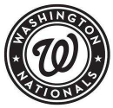 Circular badge mark — U.S. Reg. No. 5,424,583 (Class 25, clothing; first use in commerce Nov. 30, 2010)
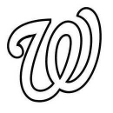 Script W — U.S. Reg. No. 3,276,405 (asserted family; first use in commerce Nov. 22, 2004)
 Capitol-dome W — U.S. Reg. No. 7,303,544 (Class 25, clothing; first use in commerce Dec. 1, 2018)
 Block W — U.S. Reg. No. 1,654,941 (Class 25, clothing — caps; first use in commerce 1960)
Chicago Cubs — Asserted “W” Mark
The Cubs Club asserts a single core stylization of the letter W, used since long before the WNBA’s constructive first-use date, across seven federal registrations spanning International Classes 14, 18, 24, 25, 28, and 41 — covering apparel, bags, jewelry, toys, and entertainment services. The opposition states that all seven of the Cubs Club’s asserted registrations are incontestable.
 Block W — U.S. Reg. Nos. 3,053,475; 4,951,429; 5,001,872; 5,223,893; 5,228,811; 5,492,561; 5,740,044 (asserted family, Classes 14, 18, 24, 25, 28, 41)
Marks reproduced from the Notice of Opposition filed with the U.S. Trademark Trial and Appeal Board, Opposition No. 91309516, for purposes of reporting and commentary. All trademarks are the property of their respective owners. No affiliation with or endorsement by the WNBA, the Chicago Cubs, or the Washington Nationals is implied.
Why “Standard Characters” Matter
One of the most consequential and most easily overlooked aspects of this dispute is that THE W is not an application for a particular graphical logo.
A standard-character application claims wording without limitation to any specific font, size, or color. As the USPTO has explained, the rights in such a mark reside in the wording or literal elements themselves, rather than in a particular visual display.
That has real consequences here. The Cubs and Nationals don’t need to compare their designs solely against whatever typeface the WNBA currently uses commercially. Because the WNBA’s registration would cover THE W without any claim to specific stylization, both Federal Circuit and TTAB precedent permit consideration of the reasonable range of ways a standard-character mark might be displayed when comparing it to a special-form mark. See Citigroup Inc. v. Capital City Bank Group, Inc., 637 F.3d 1344, 1353 (Fed. Cir. 2011); In re Viterra Inc., 671 F.3d 1358, 1364–65 (Fed. Cir. 2012).
Notably, the opposition itself leans into this point directly, alleging that because THE W is a standard-character mark, its registration “could give Applicant rights in Applicant’s Mark in any stylization, including the stylizations of certain of Opposers’ W Marks.”
That said, breadth is not equivalence. A standard-character application doesn’t automatically absorb another party’s logo, and no stylized W automatically becomes legally identical to THE W. The marks must still be compared in their entireties, and likelihood of confusion remains a multifactor analysis. This distinction may well sit at the center of the proceeding.
Is “THE” Enough?
The opposition takes direct aim at the difference between W and THE W, alleging that WNBA’s mark is “nearly identical to certain of Opposers’ W Marks, differing only by the non-distinctive word ‘THE.’“ That theory effectively places all of the source-identifying weight on the letter W itself.
But trademark comparison isn’t performed by mechanically subtracting words. The TTAB evaluates marks in their entireties appearance, sound, meaning, and overall commercial impression under the familiar du Pont framework.
The real question is more nuanced: when a consumer sees THE W on a jersey, cap, or sweatshirt, what source-identifying impression does the mark actually create?
If consumers primarily read W as the dominant element and associate specific presentations of that letter with one of the opposers, the clubs’ position strengthens. If instead consumers perceive THE W as a unitary phrase identifying the WNBA or women’s professional basketball or if the marketplace shows that W marks are crowded enough that consumers have already learned to distinguish among them based on relatively small differences the analysis could tilt differently.
These are evidentiary questions the opposition raises but doesn’t answer.
The Apparel Overlap May Matter More Than the Letter
The dispute becomes considerably more interesting once the marks are considered alongside the goods.
This isn’t a case where one party uses W for baseball entertainment while another seeks THE W for an unrelated product category. The WNBA’s application expressly covers jerseys, hooded sweatshirts, caps, hats, shirts, T-shirts, cardigans, sweaters, footwear, socks, outer jackets, shorts, and pants — and both opposers’ asserted registrations cover many of those same or closely related products under Class 25.
That matters because likelihood of confusion is never assessed by comparing marks in isolation. The relevant du Pont factors include the similarity of the marks, the relationship between the parties’ goods and services, channels of trade, purchaser sophistication, the strength of the prior mark, and other marketplace evidence. See In re E.I. du Pont de Nemours & Co., 476 F.2d 1357, 1361 (C.C.P.A. 1973).
Here, the overlap in sports apparel is direct — and sports apparel is an unusual trademark environment. A letter placed prominently on a cap or jersey can function very differently than the same letter buried in a longer corporate name. Team insignia often serve as the primary signal of source, affiliation, or sponsorship, which could make the placement and presentation of W particularly significant to the outcome.
But Does Anyone Actually Own “W”?
No — and that’s precisely what makes this proceeding worth watching.
Trademark rights generally don’t confer ownership over words, symbols, or letters in the abstract. They protect source-identifying use in connection with particular goods and services, within a legally cognizable zone of expansion.
The record itself illustrates the point: the Nationals Club asserts four distinct W stylizations, and the Cubs Club asserts a separate one — eighteen federal registrations between them, apparently coexisting despite sharing the same letter. That coexistence doesn’t defeat the opposition on its own, but it does spotlight the real question lurking behind the parties’ arguments: how broad is the protectable scope of any single W mark?
A highly distinctive, commercially strong mark may receive broader protection than a weak mark operating in a crowded field. Evidence of third-party registrations and marketplace use of W marks — particularly in apparel, sports, and entertainment — could become important if it enters the record.
The real question isn’t whether the Nationals or Cubs can stop anyone from using W. It’s whether the specific registration the WNBA is seeking, for the specific goods identified, creates a likelihood of confusion with the specific rights the opposers can prove. That’s a considerably narrower — and more interesting — question than “who owns W.”
Incontestability Doesn’t Mean Unlimited Rights
The opposition emphasizes that all but two of the Nationals Club’s eleven registrations, and all seven of the Cubs Club’s registrations, have achieved incontestable status. That’s meaningful, but shouldn’t be overread.
Incontestability can foreclose certain challenges to a registration’s validity, subject to statutory exceptions — but it doesn’t transform the owner of a registered W design into the owner of every possible manifestation of the letter W, and it doesn’t dispense with the likelihood-of-confusion analysis. The ultimate question remains whether registering THE W for the identified goods is likely to cause confusion with the opposers’ proven rights.
Two Opposers, Different “W” Families
One more notable feature: the Cubs and Nationals are appearing together even though their asserted W marks don’t resemble each other. The Nationals rely on a family of four distinct designs a circular badge, a script W, a Capitol-dome W, and a block W while the Cubs rely on a single core block-W stylization used across a range of merchandise categories.
That underscores something fundamental about trademark law: multiple parties can hold enforceable rights in the same word, symbol, or letter, with the scope of those rights varying based on the marks themselves, the goods and services, commercial strength, marketplace conditions, and priority.
Neither club’s W marks need to resemble the other’s for each to independently argue that THE W comes too close to its own trademark rights. The TTAB will ultimately have to analyze the rights actually established in the record — not decide, in the abstract, who “owns” W.
What Brand Owners Can Take From This
Simple marks are not simple clearance projects. A proposed mark built around a single letter, number, abbreviation, or short expression can intersect with a surprisingly large field of existing rights — often larger than it appears at first glance, and sometimes spread across multiple unrelated rights holders.
The identification of goods matters enormously. The closer the goods, consumers, and channels of trade, the more consequential any similarity between marks becomes. Here, overlapping claims to jerseys, shirts, hats, and sweatshirts place the dispute squarely within the same merchandising ecosystem.
Standard-character applications are powerful — and that power cuts both ways. Seeking protection without limiting a mark to a specific visual presentation offers valuable flexibility, but that same breadth can make prior stylized marks more relevant to the analysis, and can widen the field of marks a new application must clear against.
Strength and scope are different concepts. A longstanding or incontestable registration can be a formidable asset without granting its owner exclusive rights over every mark that happens to contain the same letter.
The Bottom Line
At first glance, Cubs and Nationals v. WNBA looks like an argument over a single letter. It’s really an argument over the boundaries surrounding that letter.
The clubs bring eighteen registrations between them, established sports brands, and meaningful overlap between their registered apparel goods and the WNBA’s application. But the WNBA is seeking THE W, not W standing alone, and the opposers still carry the burden of establishing likelihood of confusion under the governing framework.
Whether the TTAB ultimately views THE W as too close to one or more of the asserted marks will turn on the evidentiary record and the relevant du Pont factors — not on the fact that everyone involved happens to be building a brand around the twenty-third letter of the alphabet.
For brand owners, that’s the lesson worth carrying forward: trademark law rarely asks who owns a word, symbol, or letter in the abstract. It asks how consumers actually encounter it, what they understand it to mean, and where one brand’s legitimate scope of protection ends and another’s begins.
Disclosure & Disclaimer
This article is provided for general informational purposes and reflects developments in a pending TTAB proceeding as of the date of publication, based on the Notice of Opposition filed August 10, 2026 (Opposition No. 91309516). It does not constitute legal advice and does not create an attorney-client relationship. Brand owners navigating trademark clearance, opposition, or portfolio strategy should consult qualified counsel regarding their specific circumstances. Holon Law Partners’ Intellectual Property & Entertainment practice regularly advises clients on trademark clearance, prosecution, and TTAB proceedings — reach out to our team to discuss your brand’s protection strategy.