
AI and the C-Suite: What January’s Conversation Made Clear
On January 27 in New York City, Holon Law Partners and EisnerAmper convened more than 60 executives, operators, and advisors for a focused discussion on AI and the C-Suite. The conversation was moderated by Eric Postow, Chief Strategy Officer of Holon Law Partners, and centered on the real decisions leadership teams are already facing as AI moves from experimentation to enterprise reality.
What stood out was not just the turnout, but the depth of engagement. The audience asked thoughtful, practical questions—less about tools, and more about governance, accountability, talent, and board-level responsibility in an era where AI adoption is no longer optional.
What Emerged from the Discussion
Across the panel and audience dialogue, several clear themes surfaced:
AI Is No Longer a Technical Decision
AI has crossed into the domain of strategy, operations, and fiduciary oversight. As Eric Postow framed it, waiting for perfect regulation is not a strategy. AI is a convergent force across industries—law, healthcare, finance, and critical infrastructure—and leadership teams must act amid uncertainty rather than defer responsibility.
Healthcare as the Leading Indicator
Dr. Nawar Shara offered a clear view into healthcare as a proving ground for AI adoption. The limiting factors are not tools, but guardrails: governance, accountability, reimbursement models, and human oversight. His emphasis on systems within systems and a human-on-the-loop model highlighted how healthcare is already confronting challenges other regulated industries are quickly approaching.
Culture and Governance as Core Infrastructure
Jen Clark underscored that AI success begins with organizational culture. Governance must operate both top-down and bottom-up, with decision rights, accountability, and values embedded directly into workflows. Culture is not a soft concern—it is a capability that determines whether AI initiatives scale or stall.
From Pilots to Ownership
From a private equity and operating perspective, Maria Malavenda delivered a clear warning: endless pilots without enterprise intent are a failure mode. AI adoption requires collective ownership and operating-model transformation, not delegated experimentation. Without clear accountability, organizations burn time while competitors move ahead.
Why AI Fails in Practice
Evan Silberhorn provided a candid view into why AI initiatives break down in real organizations. AI fails when treated like an IT project. It succeeds when leaders focus on designing trust layers, rebuilding workflows, and reshaping talent into AI-enabled operators—people who understand the business and how to apply AI responsibly within it.
What This Means for Executives and Boards
For leadership teams, several implications are now unavoidable:
- AI risk is board-level risk
- Waiting for certainty is still a decision—and often the riskiest one
- Governance and accountability must precede scale
- Human-on-the-loop models are becoming the practical default
- Talent transformation matters more than task automation
The discussion made one point unmistakably clear: humans remain the differentiator. Judgment, ethics, creativity, and trust become more valuable—not less—as AI capability accelerates.
What’s Next
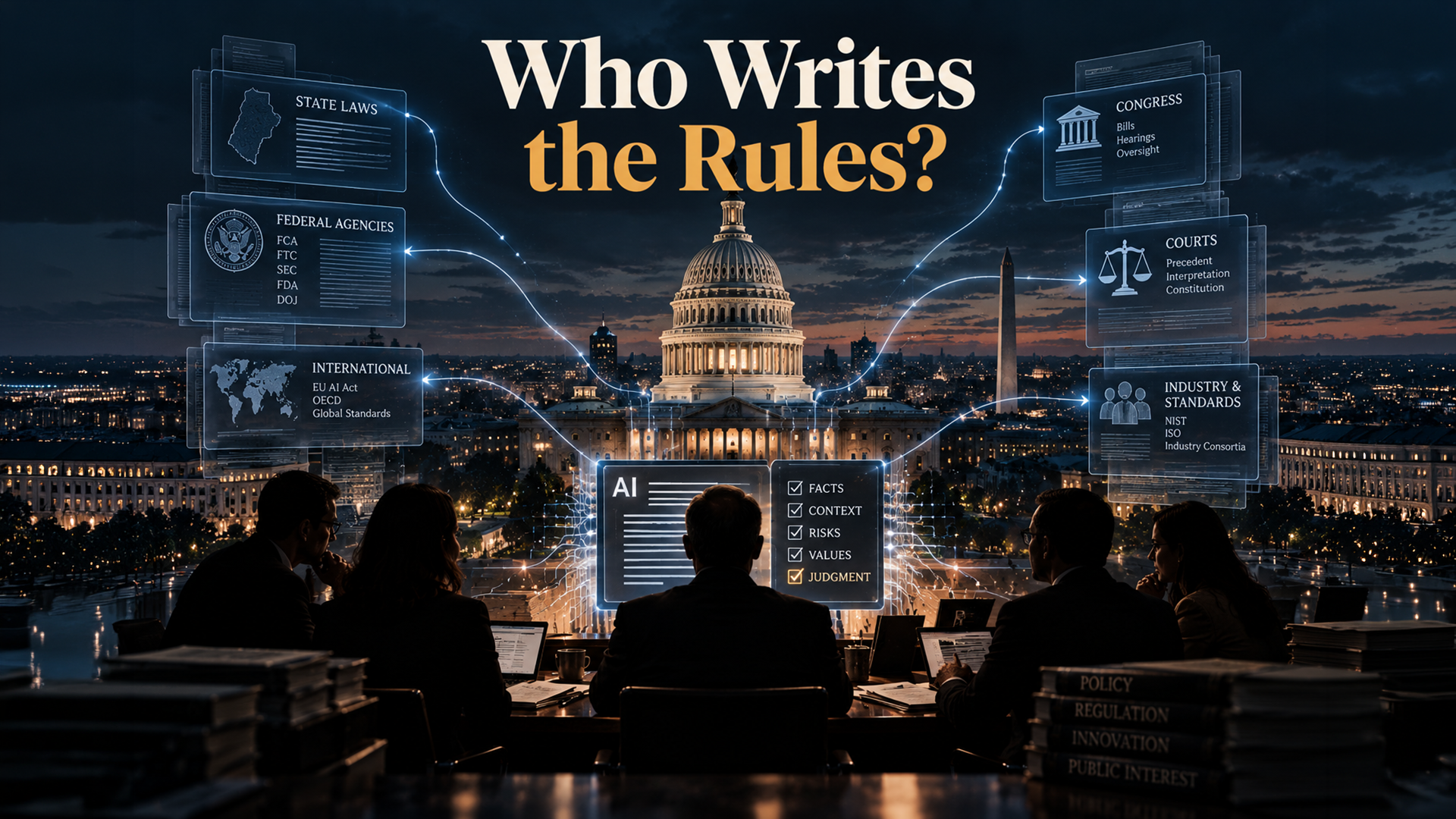
The Holon Breakfast Series returns in March, this time to Washington, DC. We’ll gather for an intimate breakfast in Georgetown to discuss AI policy and its implications for business, focusing on how emerging regulatory frameworks and federal priorities are shaping executive decision-making.
More details to follow. We look forward to continuing the conversation. To request a seat at the breakfast table please email aibreakfast@holonlaw.com and indicate your industry and interest in AI.
—
Holon Law Partners
In collaboration with EisnerAmper, KOL Ventures, and the AI CoLab at Georgetown University & Medstar Health.